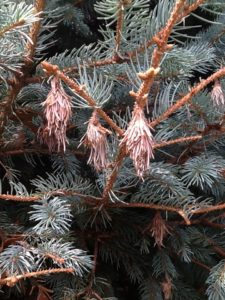
Defoliating insects cause damage to trees and shrubs by eating their leaves or needles. By doing this, you remove the tree’s ability to use photosynthesis in order to produce the next year’s growth. This damage also increases the tree/shrubs susceptibility to be attacked by other insects and diseases.
It’s important to keep any eye out for defoliating insects this summer. Knowing the early signs and getting immediate treatment can stop them in their tracks before they kill your trees and shrubs.
1. Bagworms
Native to the eastern US, bagworms are defoliating caterpillars that create unsightly cone shaped bags. When populations get high, excessive feeding can strip away large quantities of leaves.
Susceptible Trees: arborvitae, fir, hemlock, juniper, pine and spruce, bald cypress, black locust, honey locust, sweetgum and sycamore, boxelder, cotoneaster, maple, elm, buckeye, willow, crabapple, linden, poplar, and many more.
Time of Year: Late Summer
Signs & Symptoms:
Yellow spots on leaves/needles
1-1/2” – 2” cone shaped bags hanging from tree branches (seen in late summer).
These hairy insects, with areas of blue, white, black, and orange, are social species that form communal nests in the branches of trees and shrubs. These communal nests look a lot like spider webs and the caterpillars in them can easily defoliate your trees and bushes.
Susceptible Trees: Maples, willows, poplars, cherry, and crabapple.
Time of Year: Spring to Midsummer
Signs & Symptoms:
Rapid Defoliation
Easily spread to other shrubs & trees
Silky nests in the crotches of branches (Sometimes referred to as webs or tents)
Dark colored larvae visible on the tree and in the nests
First brought to the United States in 1916 in a shipment of iris bulbs, this invasive insect can defoliate an entire tree in a matter of days.
Susceptible Trees: Linden, crape myrtle, flowering crabapple, Norway maple, Japanese maple, flowering cherry, elm, sycamore, black walnut, horse chestnut, plums, roses, and many more.
Time of Year: June & July
Signs & Symptoms:
Large amounts of brown, chewed, skeletonized leaves.
Leaves falling off trees
Trees that look scorched by fire from a distance.
Beetles with a dark metallic green head and metallic dark tan wings on plants & trees.
4. Gypsy Moth
Introduced in Boston in the 1860’s this exotic pest has become a big problem throughout the Eastern United States. Gypsy moth larvae defoliate trees leaving them vulnerable to secondary invaders. The first defoliation may only cause dieback and other infestations/infections but repeated infestations can kill the tree directly.
Susceptible Trees: Oak, aspen, willow, linden, hawthorn, apple, and alder. Less susceptible trees that are commonly still infested include elms, maples, hickory, beech, hemlock, pine, spruce, cedar, and sassafras.
Time of Year: Spring through summer
Signs & Symptoms:
Holes in leaves
Thinning of tree canopy
Sprouting of old buds on the trunk and larger branches
5. Cankerworms
Cankerworms don’t occur in the summer but you should be on the lookout for them in the spring & fall. Mature, healthy trees may be able to withstand a few years of infestation; however, if you have young, weak, transplanted, or new trees, one infestation of cankerworms can severely damage your tree.
Susceptible Trees: Cankerworms have a wide host range, but prefer elm, apple, dogwood, cherry, a variety of oaks including Willow oak, linden, ash, hickory, hackberry, maple, and beech.
Time of Year: Spring & Fall
Signs & Symptoms:
Small holes on leaves
Complete defoliation that leaves the leaf veins intact.
Limb dieback
Loss of Vigor
Defoliating Insect Treatment:
If you see signs of defoliating insects this summer make sure to book a consultation with our arborist online or call 703.573.3029. Treatment may consist of a soil drench, trunk injection, foliar spray, or even beneficial control. Our arborists will be able to provide an effective treatment specific to the type of defoliator, tree species, and the level of infestation.
If you’ve seen signs of defoliating insects in previous summers your trees and shrubs are more likely to be re-infested this summer. It’s best to catch the infestation before it begins through preventative treatments. As our arborists say, an ounce of prevention is worth a pound of cure.
RTEC TreeCare has been your premier destination for customizable tree care solutions for over 25-years. Our expert team of certified arborists and tree care professionals is committed to preserving the health and beauty of your trees while ensuring the safety of your property. With a focus on environmental sustainability and the latest industry practices, we offer a wide range of services, including tree trimming, pruning, emergency tree removal, disease treatment, and more.
RTEC TreeCare has been your premier destination for customizable tree care solutions for over 25-years. Our expert team of certified arborists and tree care professionals is committed to preserving the health and beauty of your trees while ensuring the safety of your property. With a focus on environmental sustainability and the latest industry practices, we offer a wide range of services, including tree trimming, pruning, emergency tree removal, disease treatment, and more.
When a tree starts looking unhealthy, most people look up. They check the leaves for discoloration, scan the branches for dieback, or inspect the trunk
Feel free to leave your contact information on our online form. A consultation is always free, and it’s the first step towards finding a solution for your trees!