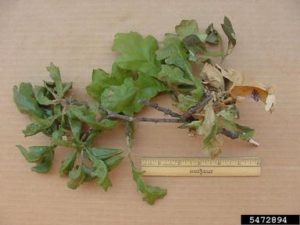
Lecanium scale is a group of common soft scale insects that feed on the sap from shade trees and woody ornamentals. If left uncontrolled, one or two major infestations can kill your tree.
Currently, these insects are in their crawler stage feeding on the sap of the tree’s leaves. They will stay in this stage throughout the summer damaging your trees. As fall approaches, the scale will move back to the branches and develop a protective shell. In this stage, they are brown and turtle-shaped about 1/6-1/8 inch in size.
Our arborists suggest keeping an eye out for signs of Lecanium scale on all trees but especially the highly susceptible tree species listed below.
Highly susceptible tree species include Maples, Oaks, Linden, and Birch.
Honeydew is the excrement of plant sucking insects such as Lecanium scale. Many homeowners confuse honeydew with sap. Trees do not drip sap. If you have “sap” dripping from your tree it is honeydew and is a telltale sign of an insect infestation.
Honeydew from Lecanium Scale Photo Courtesy of: Joe Boggs, The Ohio State University Extension
Sooty mold is a fungus that grows on top of honeydew and coats the leaves of your trees to the point where they can no longer absorb sunlight. This interrupts photosynthesis and the tree will not be able to produce the nutrients they need for survival. If your trees and shrubs are turning black you most likely have a sooty mold problem caused by an insect infestation.
Sooty Mold On Eucalyptus Tree
How Can I Get Rid Of Lecanium Scale?
Lecanium Scale In The Crawler Stage Photo Courtesy of: Utah State University Landscape IPM Advisory
It’s best to move fast when you see signs of infestation. If you catch the infestation quickly you can treat the scale while they are in the crawler stage before they form a protective shell over their body.
PREVENTION: Scale, like most insects, is more likely to feed on stressed trees. Maintaining the health and vigor of your trees can help protect against scale infestation. You can maintain the health of your tree through routine pruning, bio-stimulant applications, and seasonal sprays.
TREATMENT: Although Scale can be damaging, professional Arborists can help stop them in their tracks and prevent them from destroying your trees & shrubs through a specialized treatment program.
Specialized treatment programs will most likely include horticulture oils or insecticides and will be tailored to your landscape and other factors. One of the more interesting and eco-friendly treatments to combat scale is to use beneficial insects. Lecanium scale has many predators including lady beetles, predatory mites, and small parasitic wasps. These predators can be released onto your property in order to naturally control Lecanium scale.
If you think your trees might have Lecanium scale call book an appointment through our online booking program or call 703.573.3029.
RTEC TreeCare has been your premier destination for customizable tree care solutions for over 25-years. Our expert team of certified arborists and tree care professionals is committed to preserving the health and beauty of your trees while ensuring the safety of your property. With a focus on environmental sustainability and the latest industry practices, we offer a wide range of services, including tree trimming, pruning, emergency tree removal, disease treatment, and more.
RTEC TreeCare has been your premier destination for customizable tree care solutions for over 25-years. Our expert team of certified arborists and tree care professionals is committed to preserving the health and beauty of your trees while ensuring the safety of your property. With a focus on environmental sustainability and the latest industry practices, we offer a wide range of services, including tree trimming, pruning, emergency tree removal, disease treatment, and more.
Feel free to leave your contact information on our online form. A consultation is always free, and it’s the first step towards finding a solution for your trees!